Most budgeting apps try to remove friction.
Connect your bank. Import your transactions. Sync everything in the background. Let the app build the dashboard.
I understand why that exists. Automation can be useful. Bank sync can save time. Imports can help people catch up when they have fallen behind. For some people, that is exactly what they need.
PiggyPulse goes the other way on purpose.
It does not connect to your bank, and it does not import transactions automatically. That is not a missing feature. It is a product decision.
PiggyPulse is built around manual transaction recording because budgeting is not only about collecting data. It is also about noticing what is happening with your money.
Manual entry is slower. It takes more effort. It is less convenient than clicking a button and watching transactions appear automatically.
That trade-off is intentional.
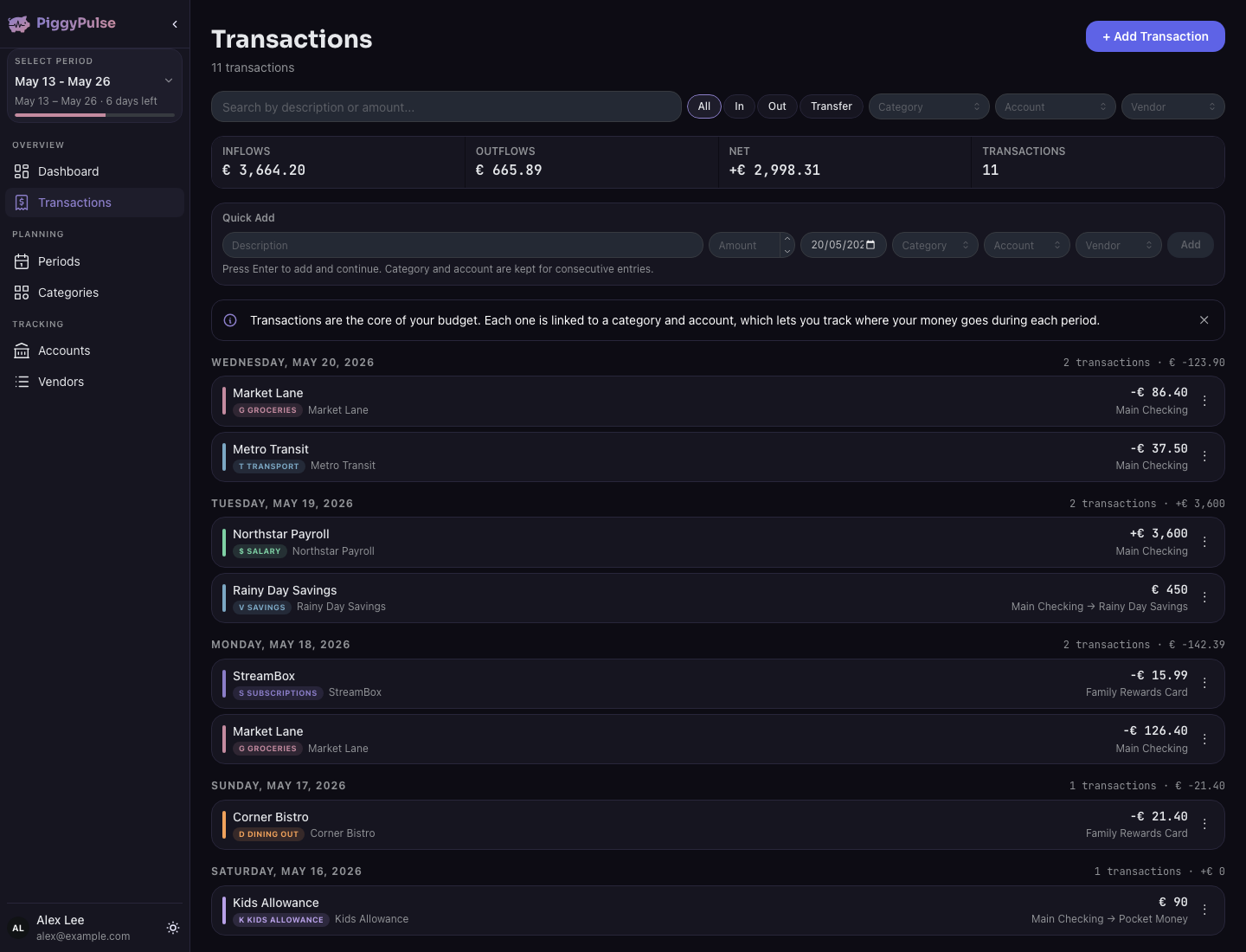
Manual entry creates a small moment of awareness
When you enter a transaction by hand, you pause.
Not for long. This is not a dramatic financial awakening under a beam of holy spreadsheet light. It is just a small check-in.
You bought something. You record it. You see the amount. You choose where it belongs. You notice what changed.
That moment matters.
If every transaction is imported automatically, the app collects the data first. Reflection happens later, if it happens at all. You might open the app days later and see a neat list of spending. The information is there, but your relationship to it can become passive.
Manual entry changes that rhythm. It asks you to be present for the transaction instead of discovering it later inside a dashboard.
That is the core idea behind PiggyPulse as a manual expense tracker. It is not trying to remove every bit of effort. Some effort is part of the point.
Why PiggyPulse does not connect to your bank
There are two main reasons I chose not to build bank connection into PiggyPulse.
The first is privacy.
A budgeting app does not need to know everything about your financial life in order to be useful. At least, PiggyPulse does not. The product is designed to be a private budget app where you decide what to enter and what to track.
Direct bank access changes the nature of a budgeting tool. It means the app is no longer just a place where you record what matters to you. It becomes something that pulls in your financial data automatically. For some products, that is the right choice. For PiggyPulse, it goes against the philosophy.
The second reason is awareness.
Automatic syncing can make a budget feel complete without making you feel connected to it. You see the result, but you may skip the moment of recognition.
Manual entry is slower. That is true. It is more work than clicking a button. It asks more from the user.
But that slowness is intentional. It creates a small space between spending and understanding. And in that space, you may notice things that automation can smooth over.
The takeaway example
Imagine you order takeaway three times in one week.
If those payments are imported automatically, they might appear later in a list. Maybe they are categorised correctly. Maybe they sit under “Food” or “Restaurants” or whatever label the app decides makes sense. You might notice them. You might not.
But if you enter those three transactions manually, the pattern becomes obvious much sooner.
- Monday: takeaway.
- Wednesday: takeaway again.
- Friday: another one.
By the third entry, you do not need a dashboard to tell you what happened. You have already seen it yourself.
That does not mean you did anything wrong. PiggyPulse is not here to scold you for ordering food like some tiny moral accountant. Sometimes takeaway is practical. Sometimes you are tired. Sometimes the week is a mess and cooking loses the fight.
The point is not judgement. The point is awareness.
Manual tracking makes repeated decisions visible while they are still fresh. You notice timing. You notice habits. You notice whether something was planned, impulsive, necessary, comforting, or just convenient.
That awareness is useful even when you do not change anything immediately.
Automation is not the enemy
I do not think automation is bad.
That would be too simple, and the world already has enough badly argued absolutes lying around like wet towels.
Bank sync and automatic imports can be helpful. If someone has hundreds of transactions a month, multiple accounts, or very little time for manual tracking, automation may be exactly what they need. A person who wants every transaction imported automatically should use a product built for that.
PiggyPulse is not trying to be that product.
This is the important distinction: automation is not evil, and manual entry is not magically superior for everyone. They are different trade-offs.
Automatic tracking gives you convenience. Manual tracking gives you more involvement.
Automatic tracking reduces effort. Manual tracking creates a little more attention.
Automatic tracking can help you see the big picture quickly. Manual tracking helps you stay closer to the small decisions that create that picture.
PiggyPulse chooses the second trade-off because it is built around privacy, control, and calm reflection.
Less convenience, more control
Manual entry means you choose what goes into PiggyPulse.
You create your accounts. You add your transactions. You decide how much of your financial life belongs in the app.
That is especially important for people who do not want a budgeting tool connected to their bank. Some people are comfortable with that connection. Others are not. Both positions are reasonable. PiggyPulse exists for the second group.
If you are looking for a budget app without bank connection, that probably means you care about keeping a little more distance between your financial accounts and the tools you use to understand them.
PiggyPulse fits that preference by design.
It does not ask you to hand over bank access. It does not pull in transactions behind the scenes. It keeps the relationship simple: you enter what you want to track, and the app gives you a quieter place to understand it.
Budgeting does not have to feel like surveillance
A lot of personal finance software has moved towards more data, more automation, more alerts, more integrations, and more “insights.”
Some people like that. Fair enough.
But not everyone wants their budget to feel like a control room.
PiggyPulse is meant to feel calmer than that. It is for people who want to slow down a little, look at what changed, and take care of their financial life without turning it into a full-time analytics project.
That is why I think of PiggyPulse as a calm budgeting app. Calm does not mean careless. It means the app should help you pay attention without making the whole process feel louder than necessary.
Manual entry supports that.
You record a transaction. You acknowledge it. You move on.
No drama. No automatic flood of imported data. No pretending that more information always equals more understanding.
A deliberate trade-off, not a missing feature
The honest caveat is simple: manual tracking takes time.
It is not easier than automatic import. It is not faster than bank sync. It is not the right fit for everyone.
There will always be people who prefer to connect their accounts and let an app collect everything. That is a valid preference.
PiggyPulse is for people who want something different.
It is for people who would rather spend a little more time entering transactions in exchange for more privacy, more control, and a more active relationship with their budget.
That does not mean PiggyPulse solves every budgeting problem. No app does, despite the internet’s ongoing effort to pretend every human issue can be fixed by a dashboard and a pastel icon.
PiggyPulse does not give financial advice. It does not guarantee that you will save money. It does not claim that manual entry automatically makes you better with money.
It simply gives you a place to track your money by hand, on purpose.
You spend money. You enter the transaction. You notice what is happening.
Over time, those small check-ins can help you understand your habits more clearly. Maybe you notice repeated takeaway orders. Maybe you notice small subscriptions. Maybe you notice that certain weeks are always more expensive. Maybe you notice nothing dramatic at all, but still feel more aware of where your money is going.
That is enough.
A budget does not always need to be a machine that optimises your life. Sometimes it can just be a quiet record that helps you stay in touch with your own decisions.
That is why PiggyPulse does not connect to your bank.
Not because automation is bad.
Because awareness is worth protecting.