Monthly Budgets Are Broken for Many People
Most budgeting apps assume your life runs on a monthly cycle.
Get paid on the 1st. Pay bills on the 15th. Review your spending on the 30th. Repeat next month.
That rhythm works well for people with a steady monthly salary, fixed recurring expenses, and a predictable calendar. For them, a monthly budget is a natural fit. The numbers align with how money actually moves through their life.
But not everyone lives on that calendar.
Some people get paid once every two months. Some work in construction and get paid when a project finishes, not when the calendar flips. Some have truly variable income — freelancers, artists, gig workers, small business owners — and trying to squeeze their finances into a monthly box creates more confusion than clarity.
Budgeting should adapt to people. Not the other way around.
The monthly cage
A lot of apps fix the budget cycle to a month. Some let you adjust the start date to match your payday. A few offer a yearly view.
But they all assume the same basic shape: fixed intervals that start and end on predictable dates.
That is fine for the person who gets paid on the 1st of every month. It is much less useful for someone whose income arrives in chunks, sometimes weeks apart, sometimes months apart.
When your budget tool expects data in neat monthly packages, your financial picture becomes misleading. A month with no income and two rent payments looks catastrophic. A month with a single large project payout looks like a windfall. Neither view reflects reality, but the tool keeps presenting them as if they do.
The problem is not your finances. The problem is that the tool only knows one shape.
Cycles you can actually shape
PiggyPulse starts with a monthly cycle by default, because most people are used to it and it is a reasonable starting point. But the default is not the limit.
The budget cycle is fully customisable. You can set any duration you want. That is not a buried setting in some preferences menu — it is a core part of how the app works.
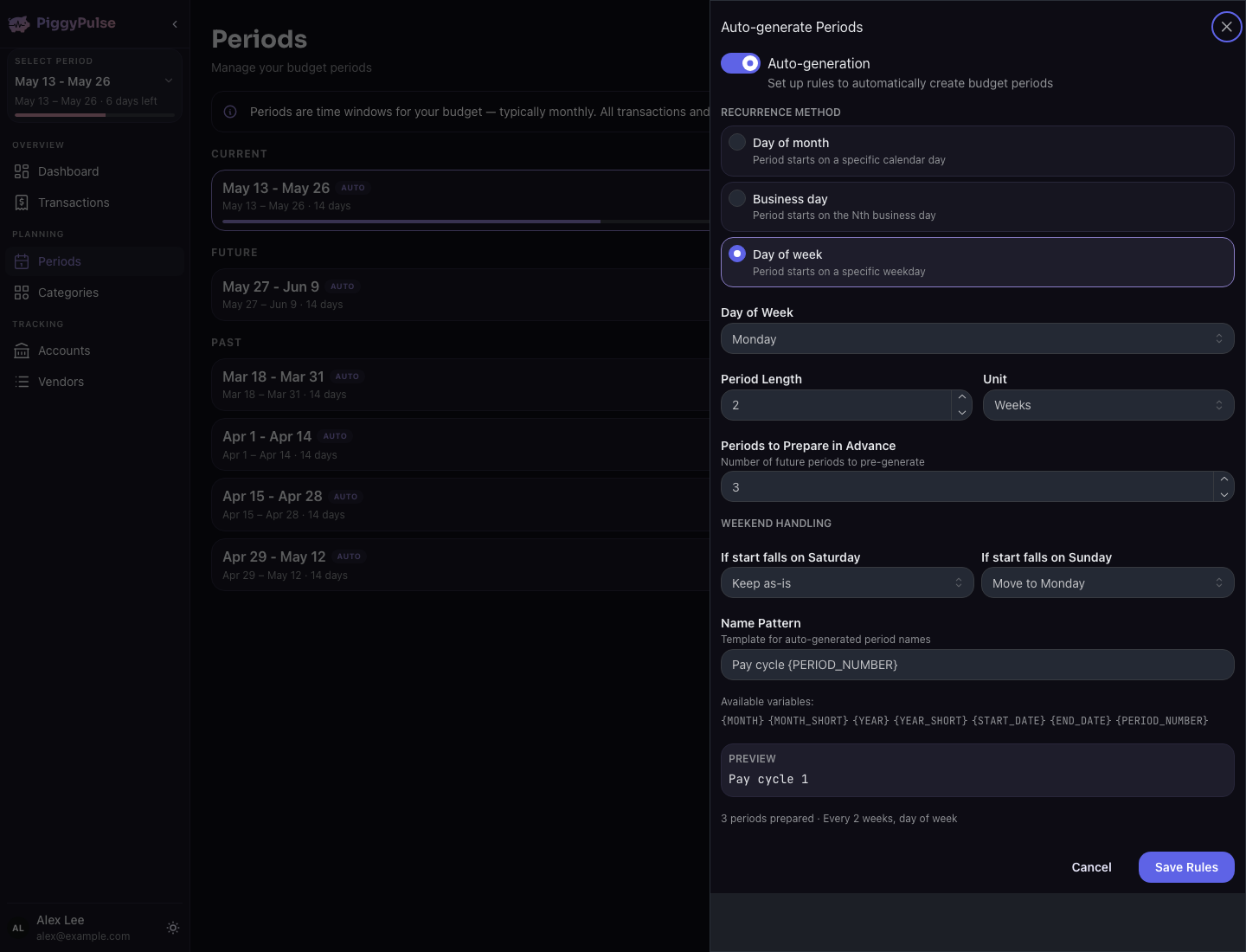
You can choose an automatic cycle that starts on a specific day, on a given business day, or on the first occurrence of a specific weekday. You pick the duration unit (days, weeks, months) and the number of units. A biweekly cycle. A quarterly cycle. A 45-day cycle that aligns with your invoicing schedule. Whatever fits.
And if automatic still does not cover your situation, you can create manual periods with a specific start and end date. That gives you complete control. One cycle per construction project. One cycle per freelance invoice period. One cycle that matches whatever shape your money actually takes.
The cycles work as a filter across all your data. Change your cycle, and every aggregation updates automatically — totals, averages, category breakdowns, everything. You are not locked into a single view. You can experiment. Try a monthly view, then switch to a quarterly view, and see what each reveals.
The construction worker’s quarter
Consider someone who works in construction. They get paid when a project wraps up. That might be every three weeks, or six weeks, or three months depending on the job.
A monthly budget tells them almost nothing useful.
One month shows zero income and a lot of spending. The next month shows a large payout from the finished project and makes it look like a spending spree when really that money has to cover the next few weeks of living costs. The dashboard is never quite right. It evens out eventually, over many months, but by then you have already spent unhelpful months looking at misleading numbers.
In PiggyPulse, that same person can set a quarterly cycle. Now the budget aligns with their actual payment rhythm. Income and expenses sit in the same period. The picture makes sense. Or they can use manual periods, setting start and end dates explicitly, so each construction project becomes its own budget cycle.
It is not that the monthly view is wrong. It is that it was designed for a different financial life.
More freedom, a little more setup
The honest trade-off: customisable periods require more setup.
A fixed monthly cycle is simple. You never think about it. It is always there, always the same. A custom cycle asks you to make a choice — how long, when to start, automatic or manual. That is one extra decision you do not have to make with a stricter app.
I think that trade-off is worth it.
A minute of configuration at the start saves months of looking at a dashboard that does not reflect your real situation. For someone with irregular income, that minute of setup is the difference between a budget that is consistently misleading and one that actually helps.
PiggyPulse was built to be a custom budget periods tool because no single cycle fits everyone. The flexibility is intentional. The small effort of setting up a period that matches your life pays off every time you open the app and see numbers that make sense.
Not every app needs to be for everyone
I am not claiming that every budgeting app should support custom cycles.
Monthly budgets work for a huge number of people. If your income is steady and your expenses are predictable, a monthly cycle is perfectly fine. You do not need more flexibility. Many apps serve that audience well.
But the people who fall outside that model are not a niche. Freelancers. Gig workers. Project-based professionals. People in industries where payment cycles do not follow the calendar. People who moved countries and are navigating a system that does not match their home country’s timeline.
Those people deserve a budget tool that fits their life, not one that asks them to pretend their life fits a monthly box.
Awareness first, judgment never
PiggyPulse does not solve every budgeting problem. No app does.
It does not give financial advice. It does not guarantee you will save money. It does not claim it can match every possible payment cycle under the sun.
But it tries something that most apps do not: it treats the budget cycle as something you should control, not something the app decides for you.
If your income arrives in chunks, if your expenses are seasonal, if your financial life does not fit into tidy monthly compartments, you do not need to change your life to fit the app.
You just need an app that can handle a different shape.
PiggyPulse can.