What Financial Apps Should Not Collect
Most budgeting apps collect more than you probably realise.
The obvious one is connecting to your bank. But look closer at what apps ask for in their privacy policies or on the App Store. Identifiers. Contact info. Location. Usage data linked to your account. Other data. All for a tool whose job is to help you track spending.
I do not mean to single out any specific app. Apple’s privacy labels make it easy to see what every app collects, and once you start looking, it is hard to unsee. You find a budgeting app asking for your precise location. Another that links your contacts to your profile. And you start wondering: why does a budgeting app need any of this?
PiggyPulse’s answer is simple. It does not need any of it.
Data minimisation is not an accident
PiggyPulse does not use tracking cookies. It does not connect to your bank. It does not ask for your location, your contacts, or your browsing history.
What does it ask for? Your email and your name. I ask for your name so I know what to call you — not so your data can be linked, analysed, cross-referenced, or sold.
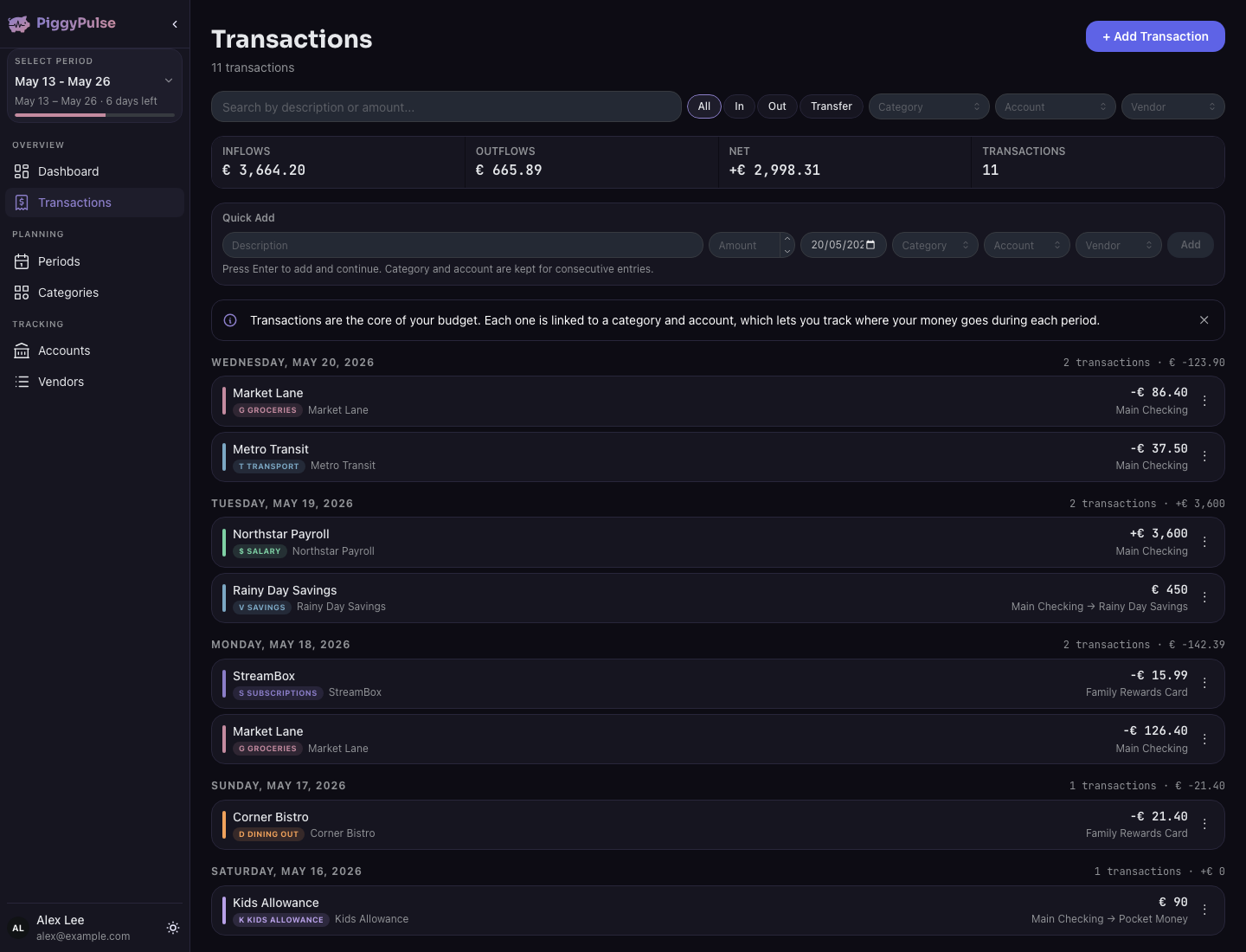
All the data inside PiggyPulse comes from you. You decide what to enter. You decide what matters. The app does not pull anything from anywhere else.
Your data is stored encrypted on servers in the EU under GDPR standards. If you ever want to leave, you can export everything or permanently delete every trace of your account.
These are not marketing bullet points. They are deliberate product decisions.
PiggyPulse was designed as a private budget app, which means privacy is not an afterthought. It is the reason the app exists.
What an app gives up by collecting less
By not collecting the same data as most apps, PiggyPulse gives itself fewer options. That is the honest trade-off.
When an app has your location, your browsing data, your spending across multiple accounts, and your contacts, it can build features that depend on that information. Personalised recommendations. Predictive insights. Behaviour scoring. Whatever the next wave of intelligent budgeting features turns out to be.
PiggyPulse cannot do any of that. It does not have the data. And that is exactly the point.
The app exists for people who would rather have less functionality and more privacy. People who want a budget app without bank connection, without tracking, without the creeping feeling that their financial tool knows more about them than they want to share.
This is the privacy versus functionality trade-off, and PiggyPulse makes its choice explicitly: privacy wins.
The six numbers that matter
Here is a concrete example of what collecting less looks like in practice.
Most budgeting apps can tell you where you spent money across every account. They can categorise transactions automatically and show trends over months and years. Some predict your upcoming bills based on patterns in your transaction history.
PiggyPulse shows you what you entered. That is it.
No automatic categorisation. No spending predictions. No AI-generated insights about your financial future. Just the numbers you typed in, organised the way you organised them.
But that limited approach also means the app cannot leak what it does not have. It cannot expose data it never collected. It cannot share information it was never given.
When you use a manual expense tracker, the relationship stays simple: you enter what matters, and the app stays out of the way. There is no background collection. No third-party tracking. No hidden pipeline pulling information from somewhere you did not think to check.
Is this approach for everyone? No. Some people want automatic insights, and there are excellent products that provide them. PiggyPulse is a different choice for people who value the trade-off.
The quiet advantage of owning less data
I want to be honest about something.
Not collecting data is not a competitive advantage in the traditional sense. It limits what the app can offer. It limits the business models available. It makes PiggyPulse harder to grow compared to apps that monetise financial data in some form.
But there is a quiet advantage to owning less data.
When your data is encrypted and stored under your control, a breach of PiggyPulse’s servers exposes far less than it would at an app that collects everything. If an app has your bank transactions, your location, your contacts, and your identifiers, a breach is catastrophic. If an app only has your email address and the transactions you entered, the scope of what can be compromised is dramatically smaller.
I do not want this article to claim that any system is 100% secure. But reducing the surface area of what is stored is one of the most effective ways to reduce risk. That is not a technical decision. It is a structural one.
A deliberate constraint, not a limitation
There is a tendency in software to collect everything, just in case. More data means more options. More data means better insights. More data means more future value.
That logic makes sense from a product development perspective. But it ignores the fact that some people do not want every app to know everything about them.
PiggyPulse exists for those people. It is a calm budgeting app that does not need the full picture of your financial life to help you manage it. It asks for less, stores less, and does less with what it has.
That is not a weakness. It is a deliberate constraint that keeps the product honest.
If you want an app that collects the minimum and respects what stays private, PiggyPulse is built for that.
If you want an app with every bell, whistle, and automated insight, there are other good options.
Both are valid. PiggyPulse just made a different choice.