How to Start Budgeting Without Shame
Most budgeting apps assume you have room to save.
Set a goal. Track your spending. Cut back on something. Reap the rewards next month. The entire system is built on the assumption that your income is at least a little higher than your expenses, and that the gap between them is something you can control by trying harder.
That assumption works great for people who have that gap. It works less well for everyone else.
And it can be deeply alienating if you are living paycheck to paycheck, or supporting a family, or dealing with financial pressure that no amount of better planning addresses on its own.
The problem is not that people do not want to budget. The problem is that many budgeting apps treat a lack of savings as a failure of effort — like the only reason you are not meeting your goal is that you did not try hard enough.
That framing creates shame. And shame is one of the best ways to make someone stop budgeting altogether.
When life does not care about your plan
Here is a scenario that most budgeting apps do not account for.
You set a budget at the start of the month. You allocate money for rent, groceries, transport, utilities, and a small amount for savings. It looks reasonable on paper.
Then the washing machine breaks. Or your kid needs school supplies. Or a medical bill shows up that you did not anticipate. Or your car needs repairs that cannot wait until next month.
The budget you wrote on the first day of the month is now wrong. Not because you failed. Because life happened.
For someone with financial cushion, that is an inconvenience. For someone living paycheck to paycheck, it can be catastrophic — and the budgeting app that shows a red warning on every category is not helping. It is adding a layer of digital guilt to a situation that already feels hard enough.
Most budgeting apps treat not saving money as a decision. Plan better, they imply, and you will save more.
But for someone on a minimum wage trying to feed a family, there may simply be no room to save. No amount of planning changes that. The app that tells you “you spent £50 more on groceries than planned” is not giving you useful information. It is giving you a reason to close the app and stop looking.
Awareness without judgment
PiggyPulse was built around a different idea.
The app does not need to tell you whether you did well or poorly. You already lived that month. You know whether that £700 shopping trip was a spending problem or a washing machine that gave up. You do not need a dashboard to interpret your life for you.
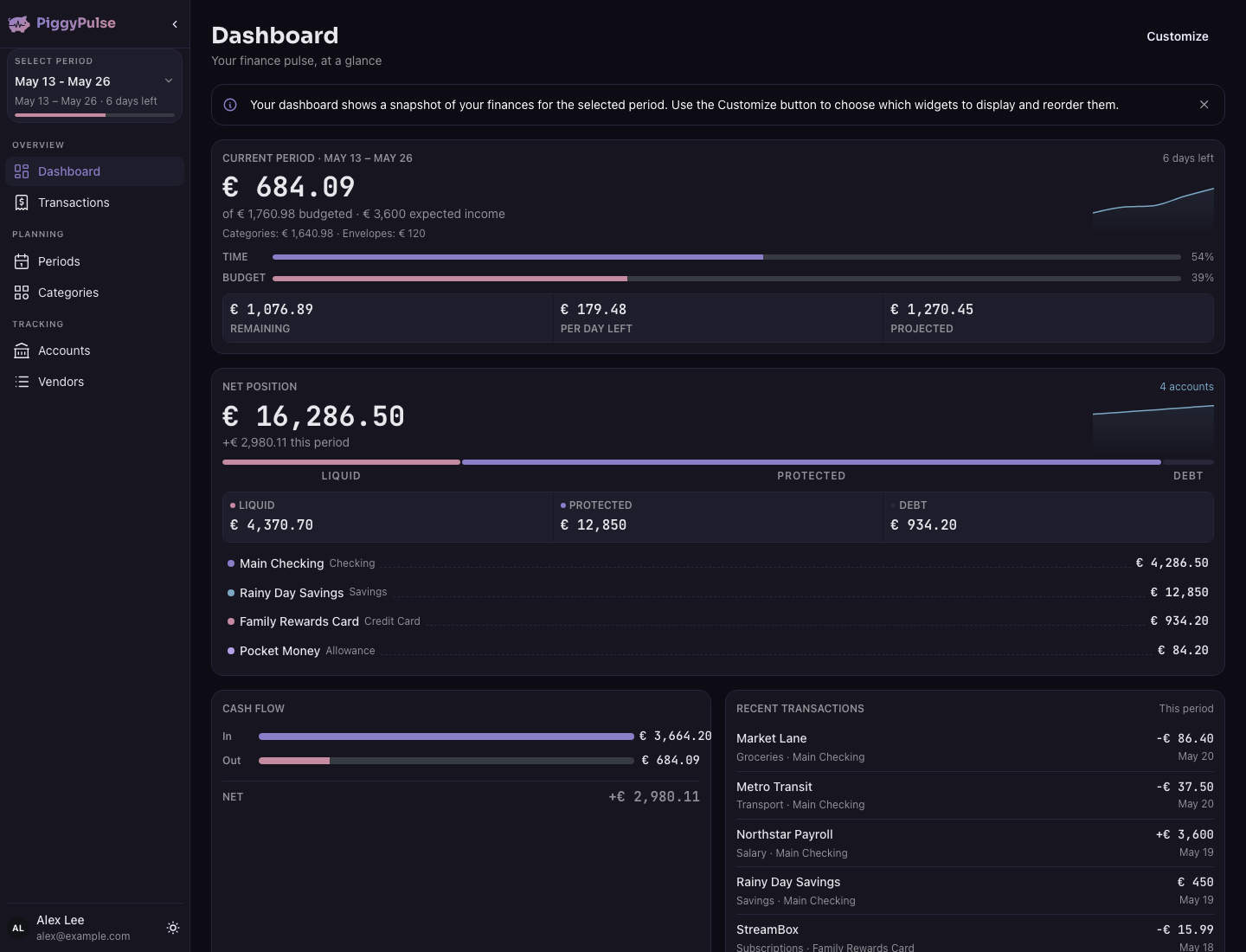
What you need is a clear view of what happened — so you can identify patterns, understand why your expenses exceeded your income, and know how much you still have before the next paycheck arrives.
That is all PiggyPulse does. It shows your spending in a way that is easy to understand. It lets you create categories without forcing you to set goals for every one of them. It tracks your spending whether you set a target or not. It never tells you that you failed.
Because when you remove the judgment from budgeting, something interesting happens: people keep using the app.
They do not open it with dread. They do not brace for a red warning. They look at their numbers, notice what changed, and move on. Some weeks that means noticing you spent too much on takeaway. Other weeks it means seeing you managed to stay on track despite a chaotic month. Either way, the app does not assign a grade.
The month rent went up by £200
Here is a concrete example.
Imagine your rent increases by £200. Your monthly budget was already tight. Now it is tighter. You cannot cut £200 from your budget without cutting something real — groceries, transport, something that will affect your quality of life.
In a typical budgeting app, every category now shows red. Overspent. Underfunded. Warning.
That is not useful information. You already know your rent went up. The app is not telling you anything new. It is just adding a layer of visual stress.
PiggyPulse shows you: you have £X left until the next paycheck. Here is what you have spent so far. Here are the categories where your money went. No red banners. No alerts telling you to fix something you cannot fix right now.
The information is there. The judgment is not.
That distinction matters because the goal of budgeting is not to feel bad about your financial situation. It is to understand it well enough to make better decisions. And you cannot make better decisions if you have stopped looking at the numbers altogether.
What PiggyPulse gives up by not celebrating you
The honest trade-off is this: some people who are able to save consistently might feel a little uncelebrated.
If you are someone who hits your savings goals month after month, you might want a cheer from your app. A little recognition. A badge or a streak or some acknowledgment that you are doing well.
PiggyPulse does not do that.
There is no confetti. No “you reached your goal!” animation. No streak counter that rewards consistency. The app stays quiet regardless of whether you are saving or struggling.
That is a deliberate design choice, but it means PiggyPulse may feel a bit flat to people who thrive on positive reinforcement. If you want your app to throw confetti when you do well, there are great apps for that. PiggyPulse is not one of them.
I think of PiggyPulse as a calm budgeting app. Calm does not mean joyless. It means the app does not fluctuate between celebration and scolding. It stays the same, no matter how your month went. You bring your own context. The app just shows the data.
A tool, not a judge
Not every budgeting app needs to be for everyone.
Some people respond to gamification. Some need a firm hand. Some want a dashboard that stays out of the way and presents the numbers clearly. None of those approaches is wrong. They are different tools for different relationships with money.
PiggyPulse is built for people who want to understand their finances without being lectured about them. It does not solve every budgeting problem. It does not give financial advice. It does not claim that using the app will automatically help you save money. And it certainly will not pull anyone out of financial hardship by itself.
It is just a private budget app that shows you where your money went, without shame, without guilt, and without pretending that a dashboard can fix everything.
The rest is up to you.
Shame has no place in a budget
Budgeting is hard enough without adding guilt to the mix.
If you have ever opened a budgeting app, seen red warnings everywhere, and closed it again because it felt overwhelming — that is not your failure. That is the app failing to meet you where you are.
PiggyPulse was built to meet you there.
Not with advice. Not with judgment. Just with your numbers, presented clearly, so you can decide for yourself what they mean.