A Calm Approach to Tracking Spending
Most budgeting apps try to make finance feel like a game.
Badges. Streaks. Confetti when you hit a goal. Red warnings when you fall short. Everything designed to keep you engaged, to keep you coming back, to make budgeting feel a little less like a chore.
I understand why that exists. Games are engaging. Celebrating wins feels good. A little dopamine can help people build habits.
But there is a problem with that approach that does not get discussed enough.
When everything is going well, gamification is motivating. You save, you meet your goals, you get your confetti. Everything works.
But when things are not going well — when you are struggling to make ends meet, when your savings goal was never realistic, when life happens and your spending goes off track — all those warnings and red indicators stop looking like motivation.
They look like punishment.
Opening the app feels like opening a report card you already know you failed. And the natural reaction to that feeling is not to try harder. It is to close the app and stop looking.
That is the problem PiggyPulse tries to solve.
Guilt is a terrible motivator
A lot of budgeting apps work on an implicit assumption: if the app makes you feel bad enough about overspending, you will try harder next month.
Missed a savings goal? Here is a red category and an alert.
Spent too much on takeaway? Here is a chart that shows exactly how badly you messed up.
The logic seems to be that a little shame keeps people accountable.
Guilt, in my view, does not work that way. Guilt does not create sustainable behaviour change. It creates avoidance. People do not learn to budget better by being told they failed. They learn by understanding their actual spending, without judgment.
That is a subtle difference, but it changes how an app should feel.
An app that scolds you for spending too much is built for people who always meet their goals. It assumes you are already on top of your finances and just need a little nudge to stay there.
An app that shows you what happened without assigning blame is built for everyone else. That is why I think of PiggyPulse as a calm budgeting app. Calm does not mean careless. It means the app should help you pay attention without making the whole process feel louder than necessary.
The £700 shopping month
It is easy to talk about this in abstract terms, so here is a concrete example.
Say you set a shopping budget of £500 for the month. By the end of the month, you have spent £700.
In a gamified app, you would see a red indicator. A warning that you exceeded your budget by 40%. Maybe a “missed target” badge.
The implicit message is that you did something wrong.
But maybe that month, your washing machine broke. You had to buy a new one. The extra £200 was a necessary one-off expense that you accounted for mentally, even if you did not adjust the budget line beforehand.
You know what that £700 means. No app needs to interpret it for you.
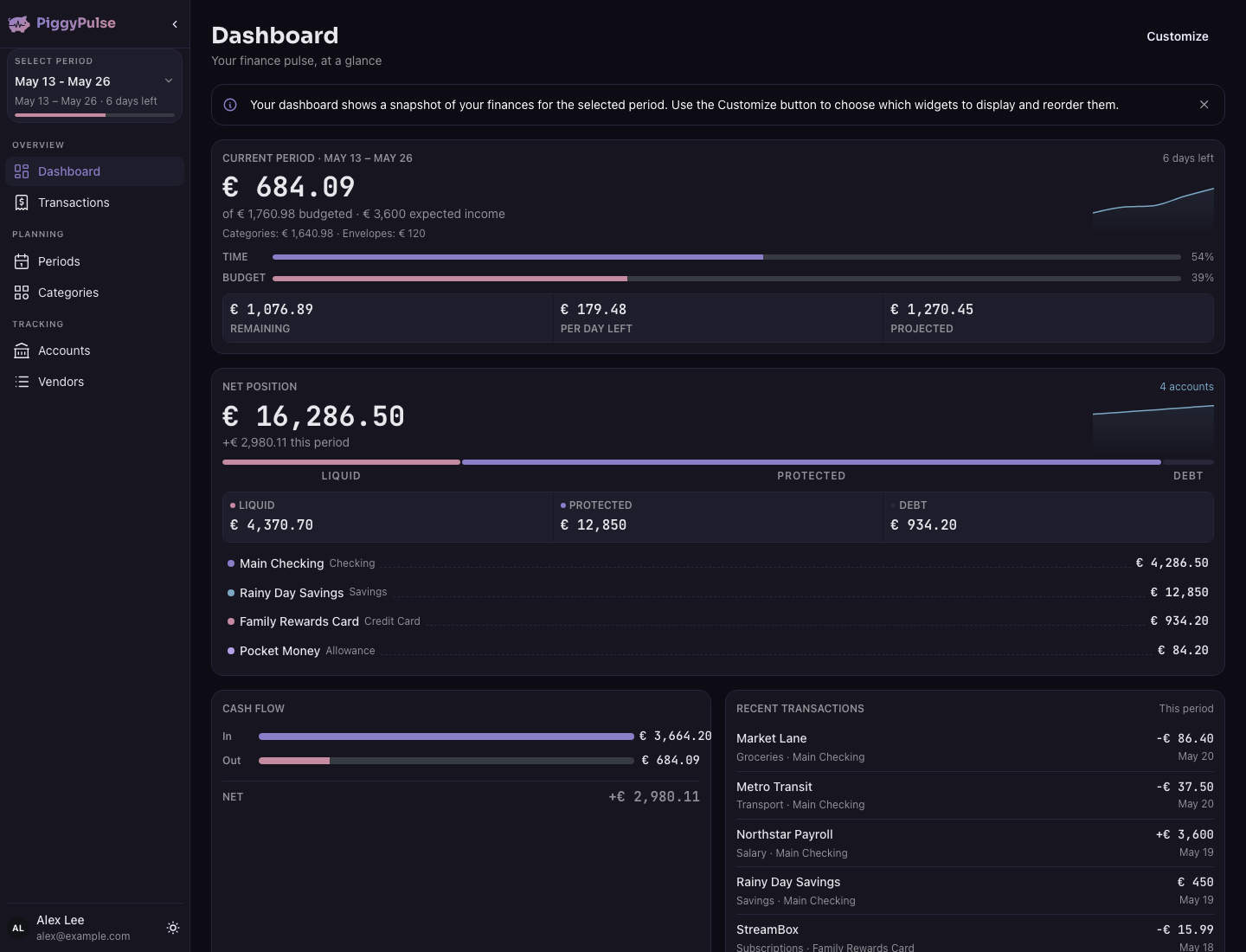
PiggyPulse shows you: you spent £700 out of a planned £500. That is it. No warnings. No shame. No celebration either, because this is not about making you feel a certain way about your spending. It is about showing you what happened so you can decide what it means.
That might sound like a small difference. But when you open the app every day, it changes how the tool feels.
You decide what your data means
PiggyPulse does not tell you whether you did a good job financially.
I believe that is not the app’s job. You lived that month. You know the context. You know whether the £700 was a problem, a temporary blip, or exactly where you expected to be. The app does not need to assign a grade.
PiggyPulse presents your data as it is. It is a private budget app by design — not private in the sense of hiding things from you, but private in the sense that your financial data stays between you and the numbers. No judgment. No unsolicited insights. Just a clear record of what happened.
This approach is not for everyone. Some people want their app to cheer them on, and that is a valid preference. If you respond well to positive reinforcement, a gamified app might work better for you.
But for people who find guilt-driven apps demotivating, for people who want to understand their finances without being lectured about them, there is value in a tool that stays out of the way and lets you see the numbers clearly.
What PiggyPulse gives up by not gamifying
I want to be honest about the trade-off.
Celebrating successes works. That dopamine hit from a “goal reached” animation can bring people back to an app. It reinforces the habit. It works for Duolingo. It works for Strava. It works for a reason.
By not gamifying success, PiggyPulse may not create that same pull. Some users will find the app too quiet. Some will prefer apps that throw confetti at them, and that is fine.
This is not a battle between right and wrong approaches. It is a question of what kind of relationship you want with your budgeting tool.
Do you want an app that rewards and scolds you?
Or do you want an app that shows you the numbers so you can draw your own conclusions?
PiggyPulse was built for the second group. Not because the first group is wrong. Because the second group is underserved.
Not every app needs to be for everyone
Gamification can be genuinely helpful. Progress bars, streaks, and achievements help many people stay disciplined. There is nothing wrong with that.
And conversely, the lack of external motivation might cause some people to stop budgeting altogether. If you need a coach, not a dashboard, PiggyPulse may not be the right fit.
That is okay.
PiggyPulse is for people who want to understand their finances on their own terms. It is for people who trust themselves to interpret their own data. It is for people who find guilt-driven apps demotivating and want something calmer.
It does not solve every budgeting problem. No app does, despite what the internet tells you.
It does not give financial advice. It shows you what happened. What you do with that information is entirely up to you.
And it will not automatically make you save money. Awareness helps, but behaviour change requires more than an app.
Awareness first, judgment never
Budgeting should not feel like a punishment. It should not feel like a game designed to manipulate your dopamine levels either.
It should feel like what it is: a clear-eyed look at your financial reality so you can make informed decisions.
PiggyPulse is built on the belief that you are the best person to interpret your own financial data. The app’s job is to get out of your way and show you the numbers clearly — without shame, without judgment, and without unnecessary fanfare.
It is not the flashiest approach. But for many people, it might be the most sustainable one.
No confetti. No red warnings. Just your data, presented honestly.